

A search for water hygiene services near me should provide you more than a list of nearby contractors. For a commercial building, public-sector site or managed estate, the right provider must show technical competence, relevant LCA (Legionella Control Association) registration, suitable laboratory arrangements, clear reporting and the capacity to manage any work that follows.
Price and postcode are important, but they should not decide the appointment. Check who completes and reviews the work, how the company escalates urgent findings and whether it can close remedial actions.
What do water hygiene services include?
Water hygiene services can cover the full risk-control cycle. The exact scope depends on the building, its occupants, the water systems and the findings of the current risk assessment.
A programme may include:
- Legionella risk assessments, schematics and a written scheme of control
- Routine Legionella monitoring, including temperatures and asset inspections
- Water sampling and analysis
- Tank, calorifier and TMV checks
- Cleaning, disinfection and showerhead maintenance
- Corrective plumbing and other remedial work
- Training and pre-commissioning cleaning
Sampling records conditions at a specific outlet and time. It does not replace a risk assessment, and not every site needs the same sampling schedule. The assessment should shape the written scheme, monitoring frequencies and any further investigation.
Life Environmental’s water hygiene services bring these activities into one managed programme.
Not sure which water hygiene service you need?
A request for “Legionella testing” may point to a wider assessment, monitoring or record-keeping gap. Life Environmental can review the building, current records and water systems before recommending an appropriate scope.
Speak to a Water Hygiene Specialist
Why does the provider you choose matter?
You can appoint an external specialist, but the dutyholder and responsible person still need to oversee the arrangements and act on the findings.
HSE’s ACoP L8 sets out a continuing process. Organisations need to identify and assess risk, prepare and implement a control scheme, monitor precautions, keep records and review the controls.
A completed assessment is one part of that process, not the finish line. The gap between assessment, monitoring and repairs can leave open actions, unclear ownership and incomplete records. A good provider makes those connections visible.
Seven checks before choosing a water hygiene provider
Use these checks to compare the evidence behind each quotation, rather than comparing price and service labels alone.
1. Can the provider reliably cover your location?
“Near you” should describe operational coverage, not just an office address. The provider needs enough people and planning capacity to meet scheduled visits.
Ask:
- Where are the engineers who will serve your contract based?
- Does the company employ them directly?
- Which tasks, if any, will it subcontract?
- How does it handle reactive attendance and urgent findings?
- Who monitors regional performance and missed visits?
- Can it apply the same standards across a multi-site portfolio?
The LCA itself notes that a member’s registered office does not show where it has staff or where it can deliver services. Check the proposed delivery model rather than assuming the closest address offers the strongest coverage.
2. Who will do the work, and are they competent?
Ask who will attend, who will review the findings and who can make technical decisions. Request evidence of:
- Relevant knowledge and training
- Practical experience with comparable systems
- Current competency records
- Suitable supervision and technical support
- Authority to escalate risks
- Familiarity with the building type and occupant profile
Avoid vague claims such as “fully certified”. ACoP L8 is an Approved Code of Practice, not a universal personal certification. No single certificate proves competence for every system.
3. Is the company LCA registered for the work you need?
LCA registration provides a useful independent check, but you need to look beyond the badge. The LCA is a voluntary organisation. It registers service providers against defined categories and audits the management systems behind those services. The directory for:
- The provider’s legal company name
- Its current listing
- The service categories shown
- Any subcategories relevant to your systems
- A clear match between the listing and the quotation
Risk assessment, hot and cold-water monitoring, cleaning and disinfection, sampling, training and plant services sit in different categories. Hence, it is advised to check the water hygiene specialist on the area of risk assessment specifically.
4. What happens to samples after collection?
Sampling gives a snapshot. The provider should explain why it recommends a sample and what decision the result will inform.
Ask for the name of the laboratory and whether it is internal or external. Then check that the relevant test method sits within the laboratory’s current UKAS scope. UKAS makes clear that accreditation applies to specified activities, which appear on the organisation’s schedule. A general UKAS logo does not cover every test a laboratory might offer.
- The sample collection and transport process
- The method the laboratory will use
- Who will interpret the result
- The reporting timescale
- The escalation route for unusual or high results
- The action expected after the result
Laboratory analysis has little operational value if nobody owns the next decision.
Reviewing water hygiene providers?
Life Environmental can explain its delivery model, service scope, laboratory arrangements and reporting process before you commit to a programme. Use that information to compare quotations on evidence, not just headline price.
5. Can the provider connect assessment, monitoring and remedial work?
A managed programme should follow a clear sequence:
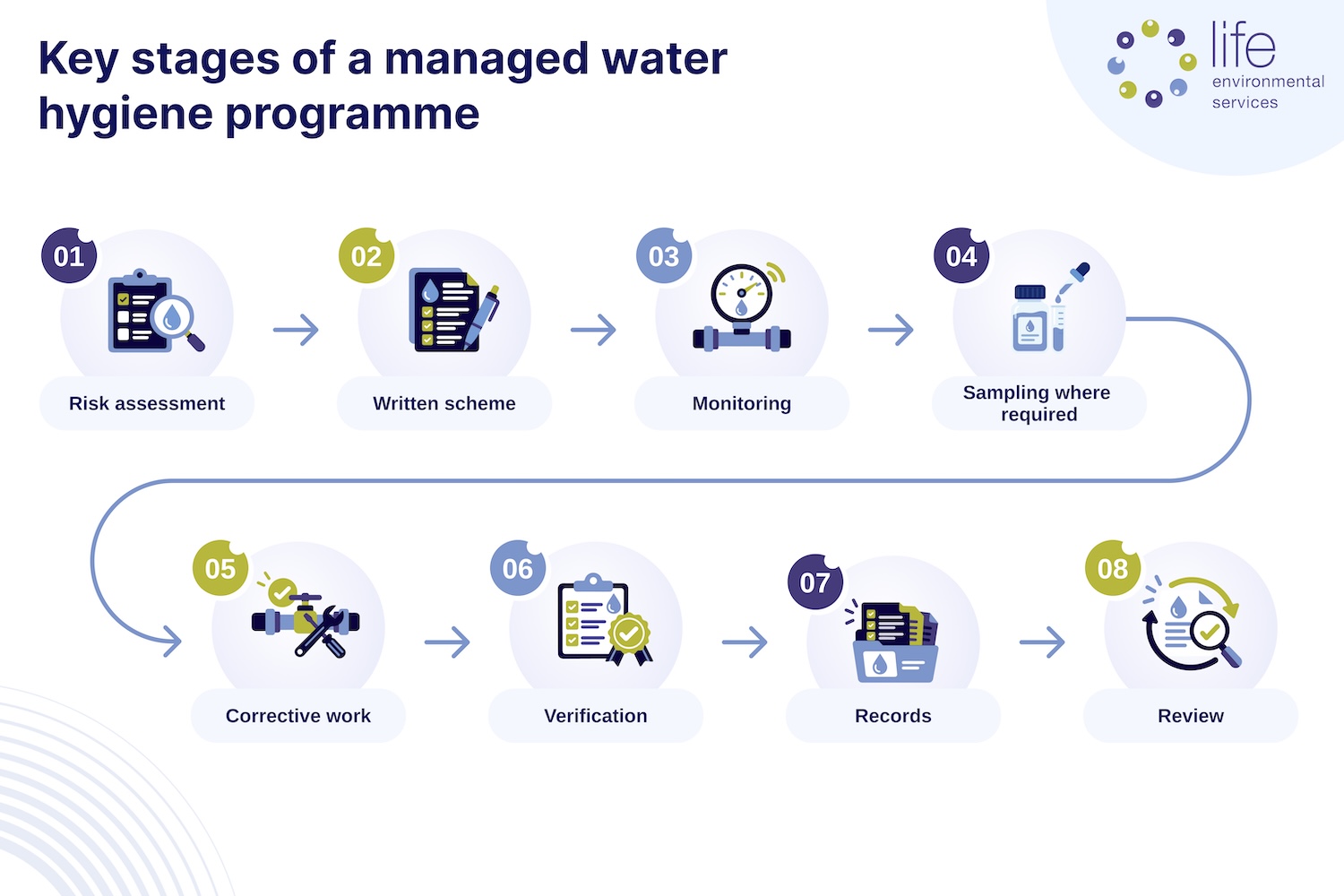
Ask which services the provider delivers directly and which it subcontracts. Confirm who turns assessment findings into a work plan, who approves changes and who verifies completion.
A provider with access to Legionella remedial works can shorten the gap between identifying and correcting a fault. Water hygiene training can also help the responsible person and site teams understand their roles.
For new or modified systems, pre-commissioning cleaning should form part of the project plan rather than an afterthought.
6. Will the reports help you manage actions?
A useful report tells the responsible person what the provider inspected, what it found, what needs action and who must act next.
For a portfolio, ask how managers can filter overdue tasks, repeat failures and risk-critical actions across sites.
7. Has the provider managed comparable buildings?
“Commercial experience” covers too much. Ask for evidence from estates with similar water systems, access limits, occupants and reporting demands.
Healthcare, education, housing and industrial estates all bring different access, occupant and continuity risks. Ask for evidence that matches your setting.
For example, Life Environmental’s project with the University of Bath describes delivery across 127 academic, residential, laboratory and sports facilities.
The contract includes risk assessments, routine monitoring, sampling, remedial works, daily performance tracking and accurate digital reporting. Life Environmental reports zero backlog in risk-critical monitoring tasks on that programme. These results relate to that contract and do not guarantee the same outcome elsewhere. Ask before accepting a water hygiene quote.
Concerned about gaps in your current contract?
A provider review can uncover missed monitoring, unresolved actions, weak reporting or unclear responsibilities. It also gives you a factual basis for deciding whether to amend the current scope or seek a different delivery model.
Is a local or nationwide water hygiene provider better?
Neither model is automatically better. Local providers may offer shorter travel times and familiar contacts, while nationwide providers may provide central oversight, consistent reporting and broader portfolio coverage.
Compare the delivery model behind the claim. Check engineer coverage, capacity, technical standards, remedial support, subcontracting and how the provider maintains consistent performance across multiple sites.
Life Environmental combines regional delivery with national oversight through its network of six UK locations.
Is your water hygiene programme under control?
Risk assessments become outdated, monitoring can slip and remedial actions may remain open. Fragmented records also make it harder for the responsible person to track risk.
Review whether:
- Monitoring matches the written scheme
- Urgent findings are escalated promptly
- Every action has an owner and target date
- Completed remedial work is verified
- Records remain accessible across every site
Life Environmental supports risk assessment, monitoring, water analysis, cleaning and disinfection, remedial works, training and pre-commissioning cleaning. Its specialists can review your current arrangements and recommend an appropriate programme for one building or a wider estate.