Bring your compliance needs to Life

Life Environmental Icon Decorative Pattern

Bring your compliance needs to life

We are here to help and assist your business with environmental compliance and risk management matters – we’re a trusted resource for leading companies throughout the UK – to speak to one of our team please send us a message using the form below and we’ll be in touch.

    170

    Life Environmental Icon

    Professionals

    Experienced and capable of taking on any size project

    6

    Life Environmental Icon

    Locations

    Providing nationwide coverage for all environmental service needs

    29

    Life Environmental Icon

    Years

    Decades of experience in helping businesses be compliant

    100+

    Life Environmental Icon

    Clients

    Hundreds of businesses rely on our expertise

    Who we work with

    FAQs

    A legionella risk assessment identifies where the risk exists in a building’s water systems. Legionella monitoring is the ongoing programme of checks, temperature readings, outlet flushing and inspections carried out to manage that risk. The monitoring programme is set out in the site’s Written Scheme of Control and is built around the findings of the risk assessment. The written scheme defines the site-specific monitoring programme, including what must be checked, where, how often, who is responsible and what action is required if a check is missed or a result falls outside the specified limits.
    HSG274 provides standard baseline frequencies, including weekly flushing of little-used outlets, monthly temperature checks at sentinel (nearest and furthest) outlets, and periodic tank and system inspections. Sentinel monitoring should be supported by checks at representative outlets so that the monitoring gives a suitable picture of the wider system. The exact locations and frequency of checks must be tailored to the system and its risk assessment and documented in the Written Scheme of Control. There is no fixed legal interval for laboratory sampling on typical hot and cold water systems; sampling is added where the risk assessment identifies a need, or for higher-risk systems such as cooling towers.
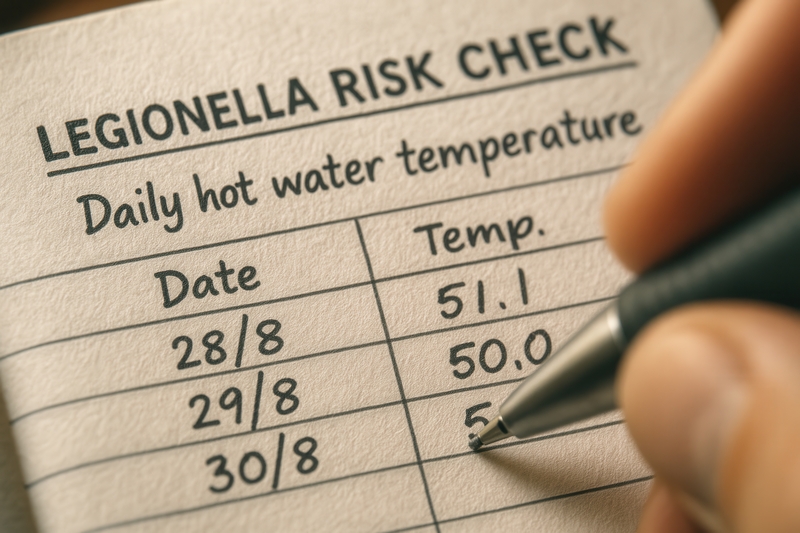
    For water systems managed using temperature control, hot water should be stored at 60°C or above and should reach at least 50°C at outlets within one minute of running. In healthcare premises, hot water should reach 55°C at outlets within one minute. Cold water should reach below 20°C within two minutes at sentinel outlets. Where thermostatic mixing valves (TMVs) are fitted, appropriate supply-temperature checks should also be carried out, alongside controls to prevent scalding. Mixed outlet temperatures should be assessed against the relevant TMV and scalding-control requirements, rather than simply being compared with hot-water distribution temperature targets. Checks and control limits should be selected to suit the system and its risk assessment. Readings outside the specified control limits should be investigated, recorded and followed by appropriate corrective action.
    The Duty Holder, typically the employer, landlord or person in control of the premises, is responsible for managing legionella risk under health and safety legislation and ACoP L8. Day-to-day monitoring may be delegated to a competent person or specialist contractor, but the Duty Holder retains overall accountability. The Written Scheme of Control should identify who carries out each check and who receives and acts on the results. It should also explain how missed checks and failed readings are escalated, who is assigned responsibility for corrective action, the timescale for action, and how completion is verified and formally closed out. Life Environmental is a member of the Legionella Control Association (LCA).
    Records should provide a clear audit trail of the risk assessment, Written Scheme of Control, monitoring activity, temperature readings, flushing, inspections, missed checks, failed readings, escalation and remedial actions. Assessment and control-scheme records should be retained throughout the period they remain current and for at least two further years. Monitoring and inspection records should be retained for at least five years. The Written Scheme of Control should state where records are kept, who reviews them and how outstanding actions are tracked through to closure. Depending on the service agreed with the client, reporting may be provided through a digital logbook, an online portal or another agreed reporting format. The format available should be confirmed as part of the service scope.
    Any workplace or commercial premises with a water system that could create a risk of exposure to legionella needs to manage that risk. The scope and frequency of monitoring should reflect the system and the findings of its risk assessment. Higher-risk environments, such as healthcare and hospitality premises, and buildings with cooling towers or complex water systems, may require more extensive or frequent checks than a simple office building.

    We support a wide range of industries

    Supporting Social Housing

    Liaising with residents from all backgrounds requires sensitivity and expert communication, and careful planning is essential to ensure minimal disruption in tenants’ homes. In social housing, landlords are responsible for large volumes of property where budgets are tight, so cost control and certainty are key. Works carried out under the Decent Homes programme, such as kitchen and bathroom replacements, demand clear communication and planning between the client, contractor, and tenant, while the fact that work often takes place in the homes of vulnerable people makes pre-booking and precise scheduling vital. Why Social Housing clients choose Life Environmental:

    • We plan carefully to keep costs down and increase productivity.
    • Clients can log on to ‘LifeCSP’ our compliance management system.
    • We ensure effective communication from our experienced project team.
    • Clients enjoy return on investment because we keep them fully informed on our processes and progress.

    Find out how we support the Social Housing Sector

     

    Decorative Pattern